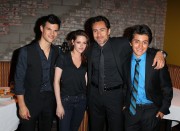
Showing posts with label A Better Life. Show all posts

Friday, November 4, 2011

Director Chris Weitz to discuss 'A Better Life' at Arizona State University

Arizona State University's Comparative Border Studies will show the film "A Better Life" at its first Fall Film Event, Nov. 15 and 16, and director Chris Weitz will be on hand to discuss the film.
The film will be shown at 7 p.m., Nov. 15 at the Phoenix Art Museum, 1625 N. Central Ave., Phoenix, and at 5 p.m., Nov. 16 in Coor Hall room 199 on ASU's Tempe campus. Both events are free and open to the public, but an R.S.V.P. is encouraged at sts.asu.edu/FallFilm.

--twilightish.com

~Robstenfan

Monday, October 17, 2011

‘Better Life’ taps human side of immigration

by The real-life story that prompted A Better Life, a moving tale of a Mexican immigrant gardener and his rebellious son, took 25 years to become a movie.
“It’s easier to make a film about aliens from other places in the universe than illegal aliens,” says producer Paul Witt. “It takes a collection of passionate individuals to get a story like this made.”
And passion certainly is the connecting link among all those involved in the critically acclaimed film, which opened in June in a limited theatrical release and comes out on DVD Tuesday.
The film grew out of an incident in the early ’80s involving the gardener of Witt’s neighbor, who lost his livelihood after his truck was stolen. He couldn’t report the theft because of his undocumented status and fear of deportation.
“It’s bad enough to be the victim of a crime, but to have to keep your head down and basically stay invisible is terrible,” Witt says.
The story stayed with the producer and came close to being made into a movie in the ’90s, but studios shied away — until recently.
“It’s certainly a more important story now than it would have been 20 years ago,” says Witt. “This issue is at the forefront of so much of American thinking, and this film puts a face on people who are only talked about in terms of numbers and as a problem.”
The film does not take sides on the issue of illegal immigration.
“We don’t see this as a political film, it’s a father-son story,” says director Chris Weitz (The Twilight Saga: New Moon).
‘You can’t help but feel’ for them
Weitz was drawn to the tale for many reasons. His grandmother Lupita Tovar, now 100, is a Mexican-born actress, and he wanted to address immigration from several angles.
“It’s inevitable that once you open a window on the life of an undocumented immigrant, you can’t help but feel a certain understanding for their situation,” Weitz says. “Even people who are very much in favor of immigration reform and quite conservative about it will understand more about the issues when they see this picture.”
Weitz, who also has German, Czech and Norwegian ancestry, learned Spanish for the film.
“I didn’t grow up speaking Spanish,” he says. “It was necessary for me to start learning it because we were shooting with a bilingual crew, and I wanted to go into neighborhoods in a manner that would be accepted and embraced by the local people.”
The film, which shot in 69 locations around Los Angeles, exposed corners of the city rarely seen in movies. One scene features a Mexican rodeo, shot about 30 miles from the city’s center.
Demián Bichir (Weeds) plays Carlos Galindo, a gardener whose stolen truck kicks off a spate of bad luck.
“Carlos is trying his best to live a low-profile kind of life,” says Bichir. “He lives in both worlds. He has to speak English with his customers and with his son and then Spanish with his friends and his sister and his everyday world.”
Seeing the unseen
The film focuses on people who often are invisible in real life. “There are many people who are washing your dishes, taking care of your lawn or your children, even in places where you don’t think there is immigration,” Weitz says. “It’s easy to ignore them because in some ways, they don’t want to be seen. They’re scared. They also often come from countries where the authorities are inherently unfriendly to poor people. “
José Julián, 17, who plays Luis, Carlos’ son, knew the milieu of the sullen teen who wants to distance himself from his dad and flirts with joining a gang.
“I’ve lived in areas that have been very gang-ridden, and I have friends who are exactly like the character I was playing,” says Julián.
Playing father and son, he and Bichir forged a strong friendship.
“During filming, we’d eat together, we’d chill in the trailer, we went to a lot of rehearsals,” Julián says. “I learned so much from that man.”
Weitz was determined to tell a tough story with empathy.
“To work the way a lot of immigrants work in this country takes such tremendous drive and fortitude,” he says. “And that’s not usually portrayed on the screen in a very positive way.”
But he didn’t want to whitewash the truths.
“This was a very realistic story,” says Weitz. “It deals with very complex, but on the surface, very simple, emotions: the love of a father for his son, the love of home, the love of country and the misunderstandings that occur between generations.”

--tucsoncitizen.com

`Robstenfan

Sunday, September 11, 2011

Chris Weitz to be Honored at CHCI Awards

 
The Congressional Hispanic Caucus Institute (CHCI) will honor CHCI alumnus Orson Aguilar, executive director at the Greenlining Institute, and Hollywood writer/director Chris Weitz at its Closing Luncheon on education during the 2011 CHCI Public Policy Conference on September 13 at the Washington Convention Center.

Read the rest of the article over at Twilightlexicon.com

~Robstenfan

Sunday, July 31, 2011

Chris Weitz: Inspired by my father the refugee


The director of 'American Pie' reveals how his German-Jewish roots influenced his new film.

Chris Weitz could have parlayed his success as the director of Twilight: New Moon into an even bigger film. Instead, he used it as an opportunity to make a small, intimate drama about a Mexican illegal immigrant called Carlos, who does back-breaking work to provide for his teenage son, Luis, while trying to keep him out of the gangs in their poor East Los Angeles neighbourhood.
On paper, A Better Life looks like an odd fit for the man behind American Pie (with his brother, Paul), About a Boy and The Golden Compass. It is, though, Weitz's most personal film to date, reflecting not only his feelings as a father, but also as the descendent of assimilated Jews who fled Germany when Hitler came to power.
In the film, a crisis forces Luis to see for the first time what his father has given up and how he will never again experience his homeland and culture in the same way. This is essentially an "accelerated" version of something that Weitz went through. Except that in his case, it was not until after his father, John, died in 2002, says the director, "that I really began to understand the aspects of history and his background that had haunted him."
Born Hans Werner Weitz in Berlin in 1923, John was the son of a wealthy textile manufacturer. He was awarded the Iron Cross after being wounded on the Eastern Front in the First World War,
In 1933, when the Nazis came to power, he was packed off by his parents to be educated in England, at The Hall Preparatory School in Hampstead, and then St. Paul's School, and, finally, Oxford University. When war broke out, he was interned temporarily in a camp near Liverpool.
His parents accepted in the meantime that there was no future for them in Germany, and escaped to America as refugees. When their son joined them, "there was nothing", Weitz sighs, the family business having been "sold for a pittance" in the rush to leave. "There is a country house in East Berlin that has been going through a legal process for 15 years, since the Wall came down. But it will probably never be returned to the family," he says.
At least America gave John a way to "strike back" at the Nazi regime. He joined the army, and because he spoke fluent German and looked aryan, he was recruited for undercover work by the OSS -- the precursor to the CIA - and became one of the first people to enter Dachau after its liberation. "He told me a story that I will never forget," says Weitz. "He talked about seeing the gas chambers and this little glass window so that the operator could see that the people had died, and described seeing taped under that glass window a picture of the gas chamber operator's daughter. That image, I think, affected the rest of his life."
Though he went on to become a highly successful fashion designer and author in America, Weitz's father never forgot where he came from or what had happened. "The story of his later years was really the story of his trying to come to grips with his German heritage," says his son. "He did believe in Germany; he did believe in it as a country. He had dealings with German resistance members, and that, I think, saved the country for him in his mind."
Nevertheless, he found it difficult to comprehend how the German "intellectual cultural elite could subscribe to the gangsterism" of the Nazis, says Weitz.
The way he sought to answer the question was, Weitz admits, "quite strange". "He had a correspondence with Reinhard Spitzy, who was Von Ribbentropp's private secretary, a Nazi."
Weitz says his father presented himself in later life as a man who was at peace with Germany and the Germans. He had even received orders of merit from the West German government in 1988, partly as a result of his work towards reconciliation.
The filmmaker was therefore surprised when, about a year ago, his mother sent him a letter that John had written around the Dachau period, containing "a great deal more anger than I had ever experienced, in terms of his expression towards the German people".
In it, his father talked about how Germans living near the concentration camp were expelled from their homes so that American soldiers could be billeted, "and he was certainly pleased to be part of this conquering army that had come back through," says Weitz.
"He was in his twenties, and I think to have been kicked out of his country and to have seen the aftermath of the massacres, and then to have won back possession of his country, literally, was a tremendous shaping experience for him."
He continues: "Certainly he was haunted by the past and brooded upon it. But at the same time, he felt that he did still love life. And, actually, England had a great part in that."
He explains that when his father went to school here, he had been "treated like a human being, having come from a country where he was a second-class citizen, or not even a human being. Because of that, he retained, for the rest of his life, a love for this country."
As we come to the end of the interview, Weitz looks across at a poster for A Better Life that is been propped up against a wall, and falls silent. He then returns to the subject of his roots.
"So yes, I'm the son of a refugee," he says, "and it took me a long time to understand the differences between my father's experiences and mine, and how much he'd sacrificed and given up to make life better for me, and for the rest of my family. Which is sort of the theme of this movie."
'A Better Life' opens today

thejc
xoxo
Carrie

Wednesday, July 27, 2011

TIFF Announces Its Lineup!

50/50
As far as movie formulas go, cancer and comedy shouldn't mix. But 50/50 defies these odds by finding the perfect balance of humour and honesty. Joseph Gordon-Levitt stars as a 27-year old nice guy who's been diagnosed with a rare form of cancer. Luckily, he doesn't have to face this dark journey alone: by his side are his best friend (Seth Rogen), his doctor (Philip Baker Hall) and a therapist-in-training (Anna Kendrick).
Anonymous
Who really wrote Shakespeare's plays? In this vivid drama from Roland Emmerich, mystery swirls around the authorship of classic plays, as the back-stabbing theatre world intersects with political intrigue at the court of Elizabeth I.
Better Life
Yann (Guillaume Canet) trained as a chef and walks with a chef’s swagger. It’s as easy for him to boast about his future plans as it is to pick up a woman in a bar, in this case the beautiful Nadia (Leila Bekhti). What he can’t seem to do is find the right job in Paris’s cutthroat restaurant world.
Butter
Olivia Wilde and Hugh Jackman star in this deliciously unlikely comedy about a Midwestern misfit thrown into the hostile, high-stakes world of competitive butter carving. Also starring Jennifer Garner, Ashley Greene, Alicia Silverstone and cult-comedy favourites Rob Corddry and Kristen Schaal.
Like Crazy
Anna (Felicity Jones) notices Jacob (Anton Yelchin) in one of her college classes in Los Angeles. In a move worthy only of her youth, she scribbles a love poem and leaves it on his car. The pair soon catapults into that most potent brand of romance: naïve, pure and possibly fleeting.
tiff for the rest
xoxo
Carrie

Monday, July 18, 2011

Illegal immigrants matter, says Chris Weitz

By YVETTE CABRERA

Article Tab: josé-julián-better-left
It is one of the most controversial and thorniest issues of our generation. But that didn't stop director Chris Weitz from taking on a movie centered on the life of an undocumented Mexican immigrant.
Too many people today – including politicians – would rather ignore the issue of illegal immigration altogether than find middle ground. Instead, we've let the divisions take over the debate.
So much so, that some have lost sight of the fact that we're talking about human beings — 11 million of them.
So when I heard of the recently released film "A Better Life," I was intrigued. Part of it had to do with my own background, being the daughter of Mexican immigrants and of a father who worked most of his life in the United States as a gardener in the well-to-do neighborhoods of Santa Barbara.
In "A Better Life," the main character Carlos Galindo (played by Demian Bichir) is a single father who is undocumented and working as a gardener in Los Angeles to support his son Luis (José Julián).
Weitz isn't the director you'd think of for this topic. Weitz's last movie was "The Twilight Saga: New Moon," and illegal immigration is about as far removed from vampires and werewolves as you can get.
But Weitz, the son of an immigrant, found himself drawn to a script that focused not on politics, but on the complicated father-son relationship that arises in this dual status family.
In the film, Carlos aspires to give his son an education. He takes a huge risk to achieve this by taking a loan from his sister to buy a truck and gardener's tools so that he can strike out on his own. Yet, despite these efforts, Carlos' son, Luis, looks down on his working-class father.
"I have a 4-year-old son and that makes you realize just how much you would do to make things better for them, to make life easier for them," Weitz says. "I began to realize that what these immigrants are doing — people who are often despised or dismissed or are invisible because we close our eyes for our own convenience — they are really doing what anybody would do."Interestingly, while the film landed in Weitz's lap thanks to a producer who knew of his Mexican heritage (his maternal grandmother is the Mexican actress Lupita Tovar, best known for starring in the Spanish language version of "Dracula"), he says he's come to realize how his father's experiences as a refugee from Nazi Germany also played into his decision to make the film.
"Here's the case of someone who in his own country was a second-class citizen. To him, America represented the chance to refashion his entire life and to make a life for his children in which they wouldn't suffer the indignities and hardship that he suffered at home," says Weitz, whose father, John Weitz, settled in New York City and became a legendary menswear fashion designer.
Weitz says he was able to lead a privileged life due to his father's hard work and success. So although he still sees the film as a tribute to Tovar and his Latino heritage, he also feels a rush of appreciation for his dad when he thinks of "A Better Life.'
"I feel that immigration — that goal of people coming to America, to make their families' lives better — is a universal one," says Weitz, who's co-directed such films as "About a Boy" and "American Pie."
And that's the strength of "A Better Life." Though Carlos Galindo is from Mexico, he could be from anywhere. And the struggle he faces as he tries to teach his defiant son how to navigate life's difficult moments is the struggle of any father.
Luis gets into fights at school, doesn't put much stock in his education and simmers with anger toward a father he views as a lowly gardener — a nobody — until the day his father's truck is stolen and they begin a journey not just to recover the truck, but to repair their relationship.
It's only then that Luis begins to understand what his father has gone through to give him a shot at the American Dream.
"It's really eventually about their discovering that each one of them is somebody," Weitz says.
That realization – that the undocumented immigrant is a somebody too — is a journey some in the political debate over illegal immigration have yet to take. They sneer at, vilify and attack immigrants whom they know little about.
The film's inspiration came about 25 years ago, says Weitz, when the gardener of one of the producer's friends had his truck stolen. After proposing that they go to the police and discovering that the gardener was undocumented, this friend realized he knew very little about his gardener's life.
That's why this film is well worth a trip to the theater. Because as we try to solve this illegal immigration issue, we shouldn't forget that beyond laws and economics and foreign relations, this issue also is about something as basic as love and sacrifice

ocregister.com 

~Robstenfan

Thursday, July 7, 2011

Live chat with 'A Better Life' director Chris Weitz & star Demian Bichir

r Life' director Chris Weitz and star Demian Bichir


Director Chris Weitz calls “A Better Life” the “biggest movie” he’s ever made. Given the film’s budget (about $10 million) and its subject matter (the plight of a gardener in the United States illegally) it seems like an odd statement, even more so because Weitz has made the much splashier “The Twilight Saga: New Moon,” “The Golden Compass” and “About a Boy.”
But Weitz believes the story of “A Better Life” -- which examines the often perilous personal challenges facing so many invisible people living in America -- is far more important than any subject he’s yet addressed as a filmmaker.
What made Weitz, whose grandmother was born in Mexico, want to make such a radical directing departure? How did he work with Los Angeles gang members to ensure that “A Better Life” was as accurate as possible? How does he hope the film might inform or change the immigration debate? Join Weitz and the film’s star, Demián Bichir in a live chat about “A Better Life”
 
You can read the Full transcript from the LA Times Live Chat with Chris Weitz and Demian Bichir over at gossip-dance


~Robstenfan

Tuesday, July 5, 2011

Holiday Box Office

Chris Weitz’s “A Better Life” found respectable numbers in its sophomore weekend. On 11 screens, “Life” managed a $124,000 4-day gross, averaging $11,272. The film’s total now stands at $203,000, and distributor Summit Entertainment noted that it will expand to over 100 screens next weekend, which will be the most telling weekend yet for “Life.”
indiewire for the rest
xoxo
Carrie

Thursday, June 30, 2011

SPECIAL NY & LA APPEARANCES by Chris Weitz & Demian Bichir


This weekend only, see the director and star of A BETTER LIFE in person!  Locations and showtimes listed below:

Los Angeles
Friday, July 1
The Landmark
5:20pm showtime: Chris Weitz & Demian Bichir post-screening Q&A
8:00pm showtime: Chris Weitz & Demian Bichir pre-screening introduction

Friday, July 1
ArcLight Hollywood
7:40pm showtime: Chris Weitz & Demian Bichir post-screening Q&A
10:30pm showtime: Chris Weitz & Demian Bichir pre-screening introduction

Saturday, July 2
Regal South Gate Stadium 20
7:30pm showtime: Demian Bichir photo opportunity, autograph session and pre-screening introduction

Sunday, July 3
Pacific Winnetka
7:20pm showtime: Demian Bichir photo opportunity, autograph session and pre-screening introduction

Monday, July 4
Regency Van Nuys Plant 16
2:40pm showtime: Demian Bichir photo opportunity, autograph session and pre-screening introduction

New York
Saturday, July 2
Landmark Sunshine
7:15pm showtime: Chris Weitz post-screening Q&A
9:30pm showtime: Chris Weitz pre-screening introduction

Sunday, July 3
Landmark Sunshine
7:15pm showtime: Chris Weitz post-screening Q&A
9:30pm showtime: Chris Weitz pre-screening introduction


--.facebook.com
~Robstenfan

Sunday, June 26, 2011

Chris Weitz on Twilight Nods, Oscar Hopes, & the Politics of A Better Life

chrisweitz250.jpg
About three years ago, in the same year he landed the gig directing the second film in the Twilight film franchise, Chris Weitz fell in love with a script about a poor illegal immigrant and single father chasing the American dream in East Los Angeles. Entitled The Gardener, the project would feature no stars, shoot on location in gang-affiliated L.A., and would never in a million years enjoy a hundred million dollar opening weekend. Weitz had to do it. 

Read the FULL article over at movieline.com

~Robstenfan

Friday, June 24, 2011

Kristen with fan (pic) at the "A Better Life" premiere

 fiercebitchstew
via: kstewartlife


~Robstenfan

Thursday, June 23, 2011

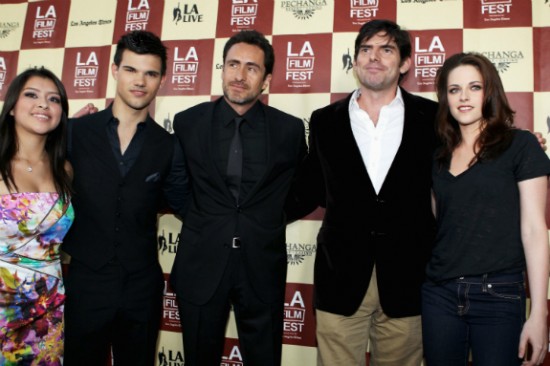
Chris Weitz At LAFilmFestival 2011

imagebam.com imagebam.com imagebam.com imagebam.com imagebam.com imagebam.com
Foforks Via TodoTwilightSaga via gossip-dance
xoxo
Carrie

First Person | Director Chris Weitz on Moving From “Twilight” to “A Better Life” in East L.A.

By Chris Weitz

Chris Weitz is the director of “A Better Life,” which will have its world premiere June 21 as a gala in the Los Angeles Film Festival, which starts tomorrow. He also directed “Twilight” franchise entry “New Moon,” “The Golden Compass” and “About a Boy,” among others. “A Better Life” will be released through Summit Entertainment June 24.
The last two movies I directed, “The Golden Compass” and “New Moon,” had the combined budgets and box office of the GDP of a small country in the Caucasus. This is something you’re meant to feel sheepish about, as though you were a dealer in, say, ground-to-air missiles rather than cinema. In fact, the experience of making these films was emotionally grueling rather than glitzy.
When I turned in my director’s cut for “The Golden Compass,” the studio concluded that I was trying to turn a popcorn movie into the world’s most expensive art film; they fired my editor and took the cut from me.
“New Moon” was all about getting back on the horse for me and working with some very talented people - Kristen Stewart, Alexandre DesPlat, the great Spanish cinematographer Javier Aguirresarobe. I wanted to make a lush widescreen romance out of a ‘tweener phenomenon and I knew the audience would come. I would say, “They’re expecting a cheeseburger, but I’m going to give them foie gras.”
This Isn’t About Atonement
Such is the naiveté of late-early-middle age. The restaurant critics were not supportive. Nonetheless, I was able to compose hybrid real-action and CGI sequences on a grand scale, create sheer cliffs and raging seas from pixels, and transform people into horse-sized wolves at the side of the legendary Phil Tippett.
We built it and they came. Our release day remains the biggest day in box-office history, a testimony to the wizardry of Summit’s marketing department more than anything else. Now, with the kung-fu of CGI at my disposal and a big old blockbuster puffing wind into my sails, it was time to find the biggest movie, with the biggest robots, the muscliest superheroes, the starriest stars…
...Except it wasn’t. My brain was shot. My home was distant. My family was unfamiliar. I had been inducted into the high mysteries of CG, but the secret inside the box was a little scrap of paper that read, “You are now making two movies at a time, not one.” I grumbled about quitting. Then, when no one tried to stop me, I returned my thoughts to a script that was then called “The Gardener.”
I found it through my friend Christian McLaughlin, one of the producers. Written by Eric Eason, the writer-director of “Manito,” it was the story of an undocumented Mexican gardener in LA. Not the guy you talk to about trimming your hedges; the much quieter guy who he tells to trim the hedges, and his son. They lived in a one-bedroom house in east LA’s Boyle Heights. The kid is in trouble at school and has no respect for his dad because the TV says people who do real work and aren’t living large are worthless. He’s on the verge of falling into gang life. Then the father gets a chance to take over his boss’ route, his equipment, his truck. Struggle, heartbreak and moral complications follow.
We’ve all seen this before, when a “big-budget” director decides to atone by making a “meaningful” film. That wasn’t quite the case here, for a number of personal reasons.
From “Twilight” to Goldilocks
First, my background. My grandmother moved here from Mexico when she was 17. My mom speaks fluent Spanish. My wife is half Cuban/half Mexican (mitad mitad, or micha micha, if you want to get into a real Mexican modismo). I, however, was a member of the first generation in my family not to speak the language - deracinated, if you will, like the boy from “A Better Life,” who can only laugh when he sees real Mexican cowboys - charros.
Second, I was an Angeleno. I emigrated here from New York 20 years ago, with the intention of returning to the old country as soon as I could. But LA was the land of opportunity. Still, there was something missing. There was a sense that parallel universes - Thaitown, Koreatown, Boyle Heights - functioned independently with little sense of what was going on in the other. There was a daily exodus of labor from east to west; there were the people standing on corners near home improvement stores. Places like South Central and East L.A. were meant to summon up dread, but what were they really like? What, if anything, united us all?
Third, I was a father. It is difficult and perhaps pointless to explain the effect this has because those who know, know and those who don’t can find it easy to dismiss as a load of self-aggrandizing piffle. Suffice to say that I had begun to learn how much one would and could do to try to make a better life for their child.
Even better, we would shoot at home. There is a thin window of budget (a Goldilocks zone, not too big and not too small) that allows you to shoot in LA as opposed to one of the tax-incentive states. This was a film that clearly had no visual cognates anywhere else. We qualified for a rebate from the state of California if (IF!) we went not a penny over our stated budget and ended up shooting in 69 locations which, believe me, is a lot of hauling your ass around.
Balanced against this was the fact that we could offer crew members the opportunity to shoot in their home city and return to their families at the end of the day. And, as it was our intention to leave a small footprint, most of our cast was worked within their own cultural backgrounds. We were a bilingual bunch, from Mexico, Spain, Puerto Rico. I caught up as quickly as I could and by the end I could bitch and moan at my heads of department with the best of them. (Helpful hints: “Que falta?” is good all-purpose Spanish for “What’s going on? Why aren’t we shooting?” The more florid “Es lente como el caballo del mal,” or, “This is as slow as the bad guy’s horse,” is a Castilian way of complaining when your crew is moving slowly.)
This Movie Needs a Priest
It’s straightforward (and the done thing) to roll into a location, pay off the locals and leave. You set up a security perimeter that ostensibly protects your stars, your equipment and your sense of your own relative importance. We wanted to do things a bit differently, so I went to see Father Gregory Boyle at Homeboy Industries.
Father Boyle is an L.A. legend. Once a parish priest in east L.A., he started Homeboys as a gang-intervention program, giving jobs to people who wanted to come in from the cold. G., as he is known around Homeboys HQ, is a father-confessor figure, a loving mentor and imitator of Christ. I’m of a different cut of cloth, but I knew instantly that I was talking to a bodhisattva.
I found G. in the acknowledgments section of a book about east L.A. housing projects. With the help of L.A. City Councilman Richard Alarcon, who want to prevent runaway production from further devastating the native film industry, I got a meeting.
I tried to seem as un-slick as possible and said that we wanted to make a movie about east L.A., the love between a father and a son, the danger of gangs and the quiet responsibility of millions of people who work invisibly in Los Angeles and elsewhere. I gave him a copy of the script and hoped for the best.
“I think this is the real deal,” emailed Father G. a couple of days later, cc’ing his 2nd in command, Hector Verdugo. “Hector, help these guys out.”
We were in. With Father G., Hector and the Homeboys backing our play, we were let into Ramona Gardens, the lively, tragic, beautiful neighborhood in Boyle Heights that also happens to be the territory of the Big Hazard gang. I have to say that I never felt scared for a moment except when a stern lady of a certain age, seeing a tracking bracelet on one of our extras, lectured me in pointed Spanish on what she perceived as the failings of our sociological approach. She didn’t want her neighborhood to be portrayed like something out of a bad TV show. Neither did I.
Authenticity at (Almost) Any Price
“A Better Life” is a story about a father and a son. Demian Bichir, the wonderful Mexican actor, was to play the father. I decided that before I even met him, seeing his performance as Fidel in Steven Soderbergh’s “Che.” He gave us the double whammy: He’s enormously technically proficient but not so recognizable to American audiences as to “throw” the movie.
With the son, we lucked out: José Julian walked into an open casting. José was the real deal. Raised by a single, undocumented parent, he was home-schooled to keep him out of trouble. Restlessly curious, he was a natural in front of the camera. With Demian as an acting coach, he jut got better and better and better.
This is the sad thing: Discounting extraneous factors, the number-one determinant if tough- neighborhood kids will join a gang is if there’s a parent at home to set them straight. Demian’s character works to hard to keep food on the table, but he’s not around to make sure José‘s character stays on the right path. As a result of his absence, the two are estranged and live in worlds as different as Malibu and Hazard Park.
To complicate matters, Demian’s no noble savage; he doesn’t have the pithy words of wisdom often attributed to cinematic working men. He’s a quiet man who wants to keep his head down, earn money and stay out of trouble. When his son asks what it’s all about, he doesn’t have the answer. Who does?
José‘s character, on the other hand, is being raised by the TV. From that, he knows there’s no place for him in the dominant culture except as a busboy or a valet. His school has given up on him; they put on a video and leave the room. And the gang is there like a black hole on the edge of the neighborhood.
I promised Father G. I would listen if he pointed out mistakes. And so, though it took us perilously close to our budgetary line in the sand, we did a re shoot when G. and Hector found something awry in a scene between Jose’s character and his best friend.
The friend seemed excited about getting jumped into the local gang; he saw it as a step up. In fact, G. explained, the usual gang-life journey is downward; a good kid starts kicking it with some knuckleheads. The phrase G. always hears when somebody talks about jumping in (and I have to say it’s fun to hear this coming from a priest) is, “Fuck it.” Fuck the future. Fuck life. We also had a swear budget of one “F” word before we lapsed into “R” territory. You can guess how we expended it.
The way these two characters begin to understand their love for each other is the story of this film. I flatter myself that it does not give any easy answers, zags when you expect it to zig and carries quite an emotional wallop. At least, that’s the idea. At the core, emotions are bigger than any special effect you can imagine—and cheaper at that.
When I hang out with Hector (I asked Homeboys for a job a while ago; we’re trying to figure something out), we don’t talk much about his past, the hard time and the gang he left. We talk about his kids—the older boy, who wants to leave the private school in Colorado that Hector managed to finagle, and his quiet, handsome Isaias, who was around a few times during the shoot.
And about my kid Sebastian, who’s about to turn four. I hope some time he’ll watch this movie by his old man, the one that he helped inspire, but we’re opening the same weekend as “Cars 2.”

indiewire
xoxo
Carrie

Chris Weitz And 'A Better Life'

imagebam.com imagebam.com imagebam.com imagebam.com imagebam.com imagebam.com
"I’ve lived in Los Angeles for twenty years, and I feel like I’ve never really known it," said Academy Award nominated Chris Weitz, at the screening of his new film "A Better Life." "There are so many microcosms that you drive past at forty miles per hour, and once you stop, and take the time to meet people, it is a really extraordinary. Los Angeles is a really beautiful place."
Los Angeles Mayor Antonio Villaraigosa, the 2011 graduating class of the Gertz-Ressler High School, and over three hundred guests joined the cast, producers and Weitz to celebrate the film's upcoming release. The screening, hosted by HuffPost's Arianna Huffington and Willow Bay, took place at the Museum of Tolerance in Beverly Hills.
The film focuses on Carlos Galindo (Bichir), a single father, gardener, and undocumented immigrant trying to ensure a good life for his American born teenage son. Galindo's struggles, as well as those facing his family and community, are presented against the backdrop of a Los Angeles that is still full of promise, yet unforgiving. "[Los Angeles] is another character, we need to tell that story too," said Bichir. Producer Stacey Lubliner echoed this sentiment: "this movie really became a love letter to Los Angeles."

huffingtonpostgossip-dance
xoxo
Carrie

Chris Weitz Dishes on Twilight Cast


E!
xoxo
Carrie

Wednesday, June 22, 2011

More from A Better Life Premiere

imagebam.com imagebam.com imagebam.com imagebam.com imagebam.com imagebam.com imagebam.com imagebam.com imagebam.com imagebam.com imagebam.com imagebam.com imagebam.com imagebam.com imagebam.com imagebam.com imagebam.com imagebam.com imagebam.com imagebam.com imagebam.com imagebam.com imagebam.com imagebam.com imagebam.com imagebam.com imagebam.com imagebam.com imagebam.com imagebam.com imagebam.com imagebam.com
kstewartfans for more
xoxo
Carrie

 

Twilight Ninjas Copyright © 2008 Black Brown Pop Template designed by Ipiet's Blogger Template